Time to Decoupage

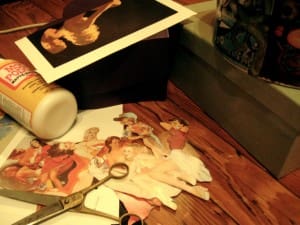

The holidays are coming, and I’ve hardly been crafty all YEAR. So now it’s time to get out the Modge Podge, and make some gifts.
Some of you know that I have a penchant for paper crafts. As in, I love doing them. There’s something very . . . zen . . . about cutting out pictures and then gluing them onto other things. Whether that other thing is a scrapbook, or a journal cover, or a hatbox . . . I just love the act of it.
So, as I stretch my much-neglected little decoupage wings for the month of December, I thought I’d share some interesting tidbits about the art with you (all of which come from the friendly and informative website, www.decoupage.org).
* Decoupage is a 20th century word which comes from the French word decouper meaning to cut out. Paper cutouts are reassembled and designed and then glued to a painted or gilded surface. The most traditional technique includes applying 30-40 layers of varnish which are sanded to a beautiful smooth sheen. However, cutouts may also be applied under glass or alternatively raised to give a three-dimensional appearance. With such a long and varied history, it is not surprising that decoupage is still evolving with new styles.
* As far back as the 12th century, Chinese peasants were creating paper cutouts in vivid colors to decorate windows, lanterns, gift boxes and other objects. This Chinese practice and expertise with scissors is thought to have come from Eastern Siberia, where cutout felt figures and designs were decorating objects in the tombs of Siberian nomads. The tombs date back to before Christ.
* [In the late 17th century] . . . the wealthy classes were using master painters to paint their furniture and decorate their walls and ceilings. However, in time, because of excessive demand and the fact that many people could not afford the works of the masters, an alternative form of decoration developed. Drawings from the artists of the day were cut out, glued down and covered with lacquer to resemble original paintings. From this derivation came the alternative term l’arte del povero-poor man’s arts.
So . . clearly it’s been going on for awhile. And you can pick up the skill, too! Just grab some magazines, some heavy glue, a paintbrush, and whatever surface you feel like sticking things onto. Paste your images on, and then give everything a coat (or two, or three) of final sealant, to make sure everything’s sealed down and varnished. And then . . . enjoy the positive feedback!
Songs In My Head Upon Waking in the Last Week:
“Here Comes Your Man,” by the Pixies; That Figaro-Figaro-Figaro song from the opera, FIGARO; “The Gambler,” by Kenny Rogers; “Cruel Summer,” by Bananarama; The theme song to “30 Rock”;
mixed up jumble of songbits; “We Are Gonna Be Friends,” by the White Stripes