Welcome, Apocalypse!

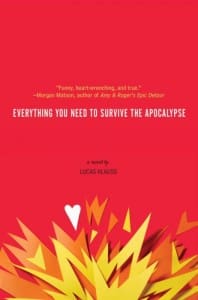
Happy 2012, everyone! Luckily, for all of us, author Lucas Klauss was wrong in his prediction that the world’s end would coincide with the release of his new novel, Everything You Need to Know to Survive the Apocalypse, yesterday, and for many reasons we’re all the better for it. For one, it means we have more time to read his book, and for two we ALSO get to see him at Little Shop of Stories on Friday, January 13th at 7 PM!!
Here’s the basics:

Phillip’s sophomore year is off to a rough start. One of his best friends ditches him. His track coach singles him out for personalized, torturous training sessions. And his dad decides to clean out all of the emergency supplies from the basement, even though the world could end in disaster at any moment…and even though those supplies are all Phillip has left of his dead mom. Not that he wants to talk about that.
But then Phillip meets Rebekah. Not only is she unconventionally hot and smart, but she might like him back. As Phillip gets closer to Rebekah, he tries harder and harder to turn himself into the kind of person he thinks she wants him to be. But the question is, can he become that person? And does he really want to?
I had a chance to interview Lucas about Everything You Need to Know to Survive the Apocalypse, and I’m relieved his doomsday-predicting skills are nowhere near as as developed as his writing skills, so that you can read what he had to say!
TEM: I think one of my very favorite things about Everything You Need to Know to Survive the Apocalypse is how it balances humor, along with genuine confusion and loss. What helped you create this successful combination?
LK: Part of it was simply self-interest. I get so bummed out when I write sad scenes. I need another element to keep me going! And humor is, for one thing, something I’m familiar with and, for another, inextricably entwined with tragedy. I think humor actually helps us explain loss and confusion to ourselves by clarifying why we find something bewildering or painful. And Phillip is always trying to figure stuff out, so it’s a natural fit (I hope).

TEM: Not a lot of us write about faith, and how complicated and challenging it can be. Can you talk some about your goals for this topic, within this book?
LK: Religion makes some people very nervous. Understandably! But I hope that readers who don’t consider themselves religious or maybe even have a dismissive attitude toward religion can gain some understanding of why faith is so important to so many people and see that evangelicals aren’t all bonkers. Conversely, I hope that this book provides readers who are religious with an opportunity to investigate their faith, what exactly they believe, and how those beliefs affect others. Those are outsize hopes to pin on one little novel. But readers will be doing the heavy lifting.
TEM: You have both an MFA and an extensive background in humor writing. How did both of these help you with Everything You Need . . ? Any times when they got in your way?
LK: Well, my MFA program helped directly in that I started writing this as my thesis project. Sarah Weeks, my advisor, gave me some much-needed encouragement and I kept going with it past graduation and finally finished my first draft about eight months later. I don’t think the program got in my way, really, but one thing I learned mostly on my own was the importance of revision. I used to be like, “I’ll just be really meticulous with my first draft and then I won’t have to revise!” Turns out, that’s not how it works.
As for humor writing, having a humor blog during the long process of writing and revising this book (over and over) helped me to not only sharpen my comedy skills but also to become a better writer in general. The constant deadline of a regularly updated blog forced me to write even more than I already did and to search for unexpected things that would make me laugh.
TEM: Rebekah, as the Girl of Interest, is so . . . well . . . interesting. She’s hot, of course, but there’s also a lot more to her, and she comes off as such a very real girl. Can you just say more about her?
LK: I’m so happy to hear you say that. I really, really wanted Rebekah to be more than just a vehicle through which Phillip gains Wisdom About Life. I hope she comes across as complex and contradictory, like anybody. She is very smart and has strong beliefs but she has some serious doubts and insecurities, too, and they’re connected to some pretty deep pain. She is friendly, even extroverted at times, but she can be hard to get to know really well. I would have been totally fascinated with and intimidated by her in high school. Just like Phillip!
TEM: Another part about Everything You Need . . that I love, and I think a lot of other readers love, is how honestly it portrays guy friendships. What do you think are the key differences between guys who are friends, and girls who are friends? Similarities?
LK: Thank you! I always loved writing those scenes, even when they were painful. The cliché is that guys don’t talk about their feelings. That’s often true but to me the more interesting thing is how guys express their feelings to each other even when they’re not stating them directly. I suspect this is also somewhat true of girls, but I have less experience in that context.
TEM: Since the world was supposed to end on the day of your book release, how did you feel about how your career as a YA novelist had gone at that point? Highlights? Low points?
LK: Honestly I am satisfied just to be a published author, even for a fraction of one, humanity-ending day. Highlights include finishing the first draft, hearing that my agent wanted to be my agent, hearing that we got an offer on the book from Simon Pulse, and the apocalypse not happening before any of that stuff. Low points include the apocalypse happening shortly after that stuff.
TEM: And what [were] your specific end-of-the-world plans?
LK: Karaoke.

TEM: But speaking of that, Phillip’s family has been preparing for the end of the world for some time. And I actually learned a few tips from reading Everything You Need to Know to Survive the Apocalypse. Did you have to do research for this part of the book? Any helpful tips you know of that aren’t included in here?
LK: I didn’t do any research, actually. I guess what’s in there are tips I absorbed during my own bouts of apocalypse paranoia, which were inspired mostly by the year 2000, hour-long Nostradamus specials on TLC, Coast to Coast AM, and a book I read called The Long Emergency, which has a cameo (with a slightly altered title) in the novel.
And I don’t have any additional tips. The title of the book is literally true—you don’t need anything else in order to survive the apocalypse except this novel! (Conveniently, I can’t really be held accountable for this claim.)
TEM: I feel like I’m always struggling with blog topics, but your blog (http://lucasklauss.com/) is consistently hilarious. How and where do you find your inspiration?
LK: Finding inspiration is actually probably the hardest part of it. I seriously spend more time trying to think of ideas that I think are funny enough to write about than actually writing them. Often what I do is try to think of existing forms of text (like a Charity Navigator list—or even something as simple as a Q&A!) and then think about how they could be subverted in some way. That’s a very fancy way of describing what is basically me sitting in a chair and biting my nails.
TEM: You live in Brooklyn, but are from Georgia, and your book takes place in Atlanta. What was the relevance of this setting for you? Could the book have been the same if you’d placed it in Brooklyn?
LK: Even having lived in New York City for over six years now, I still feel like such a suburban kid. I have a lot of affection for the neighborhoods and towns I grew up in. And I am fascinated by suburbia in general, the in-betweenness of it and the physical spaces in it and what it’s like to be a young person growing up in it.
I don’t think this story could have happened in Brooklyn. For one thing, do Brooklyn high schools even have cross country? I’m not sure where they’d do that. And there are a ton of things like that, differences that seem small but add up to a hugely different adolescent experience. Plus, tragically, there are no Waffle Houses in New York City.
TEM: Okay, lastly, what is the deal with poutine? How does anyone find that delicious?
LK: Not to insult a whole swath of French Canadians, but poutine is kind of like one of those kitchen experiments you’d do as a kid. Like, “Let’s dip salami in syrup!” And then you have to pretend that it tastes good. But, in fairness, poutine doesn’t taste bad. It just tastes exactly what you’d expect French fries covered in gravy to taste like. (The cheese curds are almost incidental, in my very limited experience.)
Thanks, Lucas, for this great book, and for spending some time talking about it with me. I’ll be seeing you on 13th, and wish you a SPECTACULAR 2012!
Songs In My Head Upon Waking in the Last Week:
“Too Many Dicks (on the Dance Floor)”, by Flight of the Conchords; “What’s On Your Mind,” by Information Society; “Enola Gay,” by OMD; “Hello, Goodbye,” by the Beatles; “Too Many Dicks (on the Dance Floor)” by Flight of the Conchords*; “Holding Back the Years,” by Simply Red; “Anarchy in the UK,” by the Sex Pistols
* Hmmm . . . Who was watching “Flight of the Conchords” during Christmas break, do you think?